
How to compare IPTV plans for your UK household
The best fit is the plan that meets your confirmed needs at a total you understand. Compare evidence about content, devices and terms instead of treating the largest catalogue, strongest slogan or longest duration as a complete answer.
Define what “best” means before comparing
A useful comparison begins with your requirements. Write down the content you want, the screens you use, the number of people watching at once and the total you are comfortable committing to. These are more useful decision criteria than an unqualified claim that one service is best for everybody.
Separate essential requirements from preferences. An exact programme or accessibility need may be essential. A larger general catalogue or a particular visual style in the app may be a preference. If a service cannot confirm an essential requirement, adding more optional features does not resolve the gap.
This is a buying-criteria guide from IPTV UK Stream. It is not an independent ranking of providers, and it does not claim that we have tested competitors. Use the same questions consistently wherever you compare, including when you assess the plans on this website.
Use an evidence table instead of a points race
| Criterion | Evidence to seek | Keep separate |
|---|---|---|
| Content | Answer about the exact channel, title or event | Total catalogue count |
| Device | Exact model, player and setup guidance | Broad platform name |
| Connections | Required simultaneous streams and permitted use | Number of devices owned |
| Cost | Whole-term total for the same configuration | Rounded monthly equivalent |
| Support | Real contact route and useful answers | Unverified response-time promises |
| Terms | Start, expiry, renewal and change arrangements | Assumptions based on the word subscription |
Mark each essential item as confirmed, unresolved or unsuitable. This avoids a misleading scoring system in which ten minor benefits outweigh one requirement you cannot do without. Keep the date and source of an answer so that you can distinguish a current confirmation from an old screenshot or someone else’s experience.
Check exact content rather than broad categories
A description such as sports, UK channels or movies is too broad to settle an individual choice. Ask about the specific channel, competition, film version or series season you mean. Include a date for an event and any language or subtitle requirement that affects your viewing.
Large counts can describe the scale of an offer, but they do not prove that your chosen item is present. IPTV UK Stream’s published Standard and Premium lists use different catalogue figures; neither figure should be treated as a verified list of every programme. The channel availability guide explains a more useful enquiry.
Also distinguish live viewing, on-demand titles and catch-up. A programme appearing in a guide is not the same as a programme being available to replay. A film in a catalogue is not evidence that a particular live channel is included. Clear categories prevent a comparison from mixing different kinds of access.
Verify the device you already own
Record the complete model name rather than only the brand. “Smart TV” can describe many platforms and generations. Note the operating system version where available and the player you intend to use. Then ask whether that exact combination supports the relevant setup.
Consider everyday usability as well as whether playback can start. Can the person who watches most often read the programme guide from the sofa? Are the remote controls understandable? Are the relevant audio, subtitle or accessibility options available on the content and player you intend to use?
A manufacturer’s technical page can support facts about the device, while a service must answer questions about its own access and content. Do not treat one as proof of the other. The compatibility hub helps organise that distinction before you spend money on new equipment.
Compare the same number of connections
Count the streams playing at the same time during a busy ordinary evening. One person moving from a television to a tablet is different from two people watching separately. Use that count consistently across every price you compare.
Ask about household and location restrictions separately. A plan advertising several connections does not, by itself, authorise sharing between unrelated addresses, passing credentials to friends or public screening. The multi-device guide explains the plan options without inventing those permissions.
Check how the count interacts with the selected tier and term. A headline price often describes one configuration only. On this website, each duration card has an independent connection selector, so align the counts before deciding that one card offers a better deal than another.
Use the full GBP total for the comparison
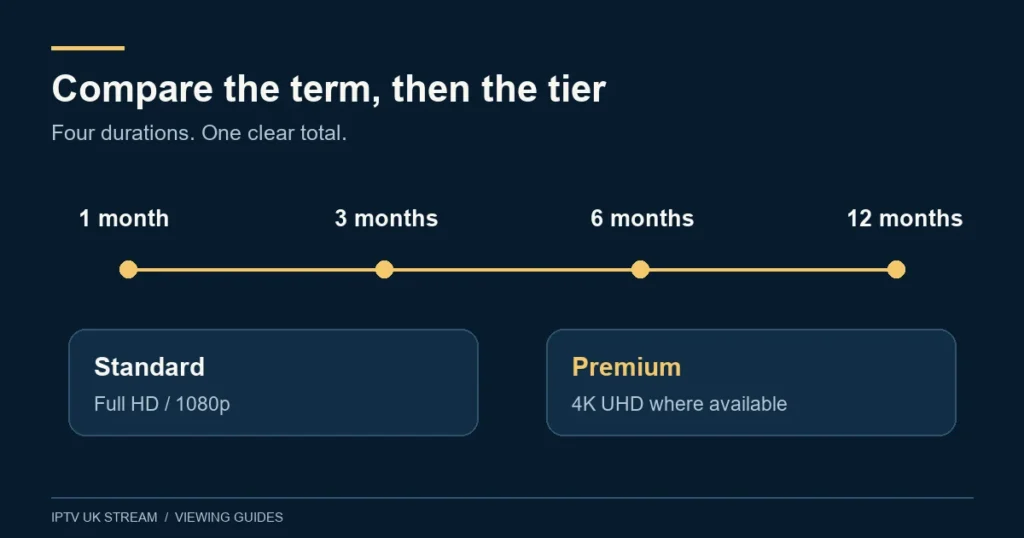
Compare the same tier or relevant feature set, the same duration and the same connection requirement. Then look at the whole-term price in pounds sterling. A monthly equivalent is helpful for understanding the cost over time, but it should not hide the amount associated with the term.
For example, the published Standard one-connection totals are £14.99 for one month and £59.99 for twelve months. The annual equivalent is approximately £5.00 a month, but that does not turn the annual option into a £5 monthly-payment offer. The term and commitment differ.
Ofcom’s consumer comparison guidance similarly encourages people assessing broadband to consider both monthly and upfront costs. That is general cost-comparison advice, not an endorsement or assessment of this IPTV service.
Avoid inventing savings from hypothetical old prices. Compare the actual current figures and label any multiplication as arithmetic, rather than a guaranteed future renewal arrangement. If an amount, currency or configuration is unclear, resolve it before proceeding.
Read performance language with the right questions
Words such as stable, premium or enhanced can be part of a supplied feature description. They should not automatically become a guarantee of uninterrupted playback, a precise response time or a measured percentage of uptime. Ask what evidence or practical assessment is available for the feature you care about.
If picture quality is central to your decision, distinguish resolution from availability. IPTV UK Stream lists 4K UHD available for Premium. That does not promise that every source is 4K or that a particular HDR format is included. The 4K guide explains the relevant checks.
For VPN descriptions, ask about the actual implementation and limitations. For catch-up, ask about specific programmes and time windows. A precise answer is more useful than expanding a short feature label into technical promises the provider has not made.
Make a trial enquiry with a purpose
If an assessment is available, decide in advance what you need to learn. Choose the intended device, normal viewing position and a small list of relevant content or controls. A trial that only opens an unrelated item on a spare phone may not answer the question that determines your purchase.
Ask what the available trial process covers. Do not assume a particular duration, number of connections or exact catalogue. IPTV UK Stream currently directs trial enquiries through its information and manual contact process; reading the page is not an activated trial.
Keep a short record of what you actually observed. Separate a confirmed result from an expectation about future availability. No short assessment can prove every possible future situation, but it can help you identify obvious compatibility or usability questions before committing to a longer term.
Clarify the arrangement before following through
Ask when the term starts, how expiry is recorded and how renewal works. If you need a pause, a device change or a different connection count later, ask about that exact case. Do not assume a refund, transfer, credit or automatic upgrade from the presence of a selector.
Use a real support route and ask a concrete question. A useful answer should relate to your actual device, content or plan choice. Keep private access details and payment information out of public screenshots. The contact page is the central route for questions about this site’s offering.
When the essential items are clear, choose the configuration you understand. The plan-selection information page explains the next available step without placing an order or charging you on arrival.
Buyer questions
Is the largest catalogue automatically the best choice?
No. A large total does not confirm the exact content you want. Check essential items and device suitability before using catalogue size as a deciding factor.
Should I always choose the longest term?
No. Compare its lower equivalent with the longer commitment and your confidence in continued use. A shorter term can suit unresolved or changing needs.
Can a comparison article prove service quality?
Only claims backed by relevant evidence should be treated as established. This page provides criteria and does not claim independent testing, rankings or guaranteed performance.
What if an important answer is missing?
Keep it marked unresolved and ask directly. Do not fill the gap with an assumption based on a slogan, another customer’s setup or a different provider’s policy.
What is the most useful final check?
Read the tier, term, connection count and full total together, then confirm that your essential content, device and arrangement questions have been answered for that configuration.